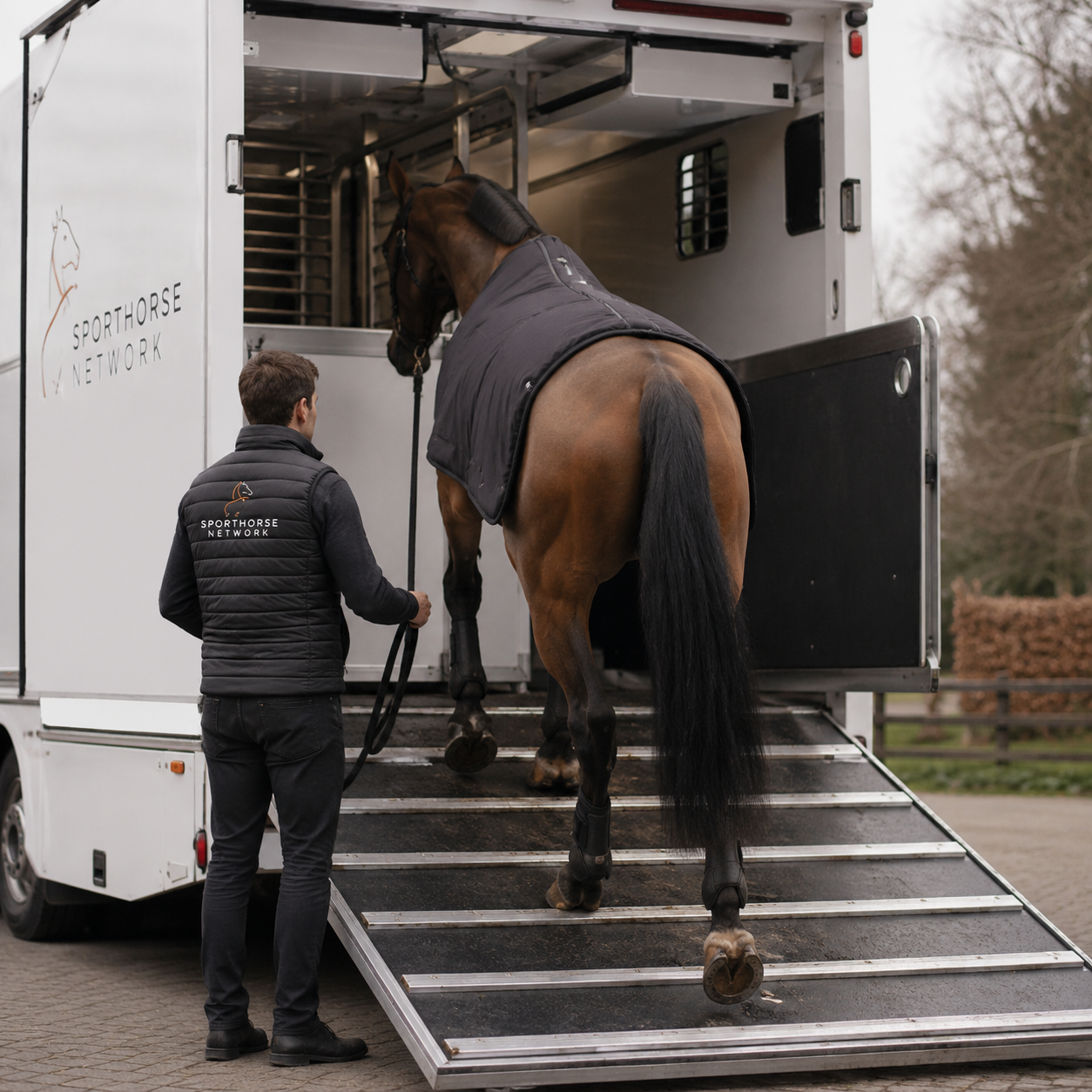
Risk transfer, usda-quarantine and insurance structure in high value sport horse transactions
In the upper segment of professional sport horse trading, transport is not a logistical afterthought. It is a legally sensitive and financially decisive phase of the transaction.
When a show jumping, eventing or hunter prospect is sold internationally — whether within the European Union, to the United States, the United Kingdom or the Middle East — transport directly affects:
• Risk transfer
• Insurance coverage
• Payment timing
• VAT treatment
• Delivery obligations
High-value international sport horse transport without contractual structure is not efficiency — it is unmanaged exposure.
Transport Must Be Embedded in the Sale Agreement
In professional B2B horse trading, transport should be addressed explicitly within the sale agreement.
The contract should clearly define:
• Who arranges transport
• Who selects and instructs the carrier
• The precise moment of risk transfer
• Liability in case of delay
• Responsibility in case of injury, illness or death during transit
• Applicable transit insurance
Ambiguity at this stage often leads to cross-border disputes — particularly when the horse is already located in another jurisdiction.
Risk Transfer in International Horse Transport
Risk transfer is one of the most litigated aspects of international sport horse sales.
Does risk transfer:
• Upon contract signing?
• Upon receipt of full payment?
• Upon departure from the seller’s stable?
• Upon loading at the airport?
• Upon delivery to the buyer’s facility?
Case example:
A Grand Prix prospect is exported from the Netherlands to the United States.
The horse sustains a minor injury during USDA quarantine. The agreement does not clearly define risk transfer.
The result: delayed payment, insurance uncertainty and legal consultation in two jurisdictions.
Professional contracts align risk transfer with transport logistics and insurance coverage.
TRACES Compliance for Intra-EU Horse Transport
Within the European Union, sport horses benefit from the principle of free movement of goods. However, live animal transport remains subject to veterinary control.
TRACES (Trade Control and Expert System) is the EU’s digital platform for tracking cross-border movement of live animals.
For professional sport horse transport within the EU, TRACES registration is mandatory.
The process requires:
• Registration of both sending and receiving establishments
• Clinical inspection by an official veterinarian
• Digital validation of the health certificate in TRACES NT
• Approval by the competent authority
Without validated TRACES documentation, transport cannot legally proceed.
TRACES documentation also supports VAT zero-rating in intra-community B2B transactions, as it forms part of the proof of cross-border transport.
USDA-Approved Quarantine for the United States
Exporting sport horses to the United States requires mandatory quarantine under supervision of the USDA (United States Department of Agriculture).
The purpose of USDA quarantine is biosecurity: protecting the U.S. equine population against infectious diseases.
Every horse entering the United States is placed in an approved federal quarantine facility upon arrival. During this period, the horse undergoes veterinary inspection and, where applicable, additional diagnostic testing.
USDA quarantine involves:
• Placement in a licensed quarantine facility
• Veterinary examination upon arrival
• Mandatory observation period (duration depends on gender, origin and health status)
• Formal clearance prior to release
Stallions and horses originating from certain regions may face stricter protocols and extended quarantine periods.
Crucially, quarantine space must be reserved in advance through a licensed import agent or experienced equine transport specialist. Without confirmed quarantine booking, air transport cannot be executed.
From a contractual perspective, parties must clearly determine:
• Who bears quarantine costs
• Who bears risk during quarantine
• Whether insurance extends through the quarantine period
In high-value transactions, quarantine is not merely procedural — it represents a defined legal risk phase.
Transit Insurance and Mortality Cover
Carrier liability insurance is typically insufficient for high-value sport horses.
Professional sellers and buyers rely on specialized equine transit insurance, which may include:
• Mortality cover during transport
• Surgical coverage during transit
• Coverage during quarantine
• Loss of Use (where applicable)
Insurance limits must reflect the agreed purchase price. Underinsurance creates immediate financial exposure if an incident occurs.
Importantly, the effective insurance period must align precisely with the agreed risk transfer moment.
Synchronizing Payment and Transport
Payment timing and transport logistics must be contractually synchronized.
If final payment is due upon arrival, but risk transfers at departure, a misalignment arises between financial and legal exposure.
Professional B2B agreements therefore align:
• Delivery definition
• Risk transfer
• Payment milestones
• Insurance activation
This alignment prevents disputes and protects commercial relationships.
VAT Zero-Rating and Export Documentation
Transport structure directly impacts VAT treatment.
Within the EU, intra-community B2B sales may qualify for 0% VAT (reverse charge),
provided that cross-border transport is properly documented.
For exports outside the EU, including to the United States or the United Kingdom post-Brexit, zero-rating applies only if valid export documentation (customs export declaration) is retained.
Without sufficient proof of export, tax authorities may reassess VAT, including interest and penalties.
Transport documentation is therefore fiscally decisive, not merely logistical.
Common Strategic Mistakes in International Horse Transport
Even experienced professionals encounter recurring issues:
• Undefined risk transfer
• Insufficient transit insurance
• No written quarantine allocation
• Lack of TRACES compliance
• Missing export documentation
These errors do not stem from inexperience, but from routine.
Routine is not a legal safeguard in international sport horse trading.
Professional Infrastructure in Direct B2B Trade
The international sport horse market increasingly favors direct professional-to-professional transactions.
Direct trade reduces intermediaries, increases transparency and accelerates decision-making. However, it also places full responsibility on the contracting parties.
Within a controlled professional network, transport structure, insurance coverage and risk allocation are addressed proactively — not reactively.
Logistical precision is part of professional credibility.
Conclusion
International sport horse transport is not a logistical detail. It is a legally and financially decisive phase of the transaction.
Professional B2B sport horse trading requires:
• Clearly defined risk transfer
• Contractually embedded transport responsibility
• USDA and TRACES compliance
• Adequate transit insurance
• Proper VAT zero-rating documentation
International trade without structured transport agreements is exposure to avoidable risk.
Professional trading begins with preparation.
Where Professionals Find Horses.