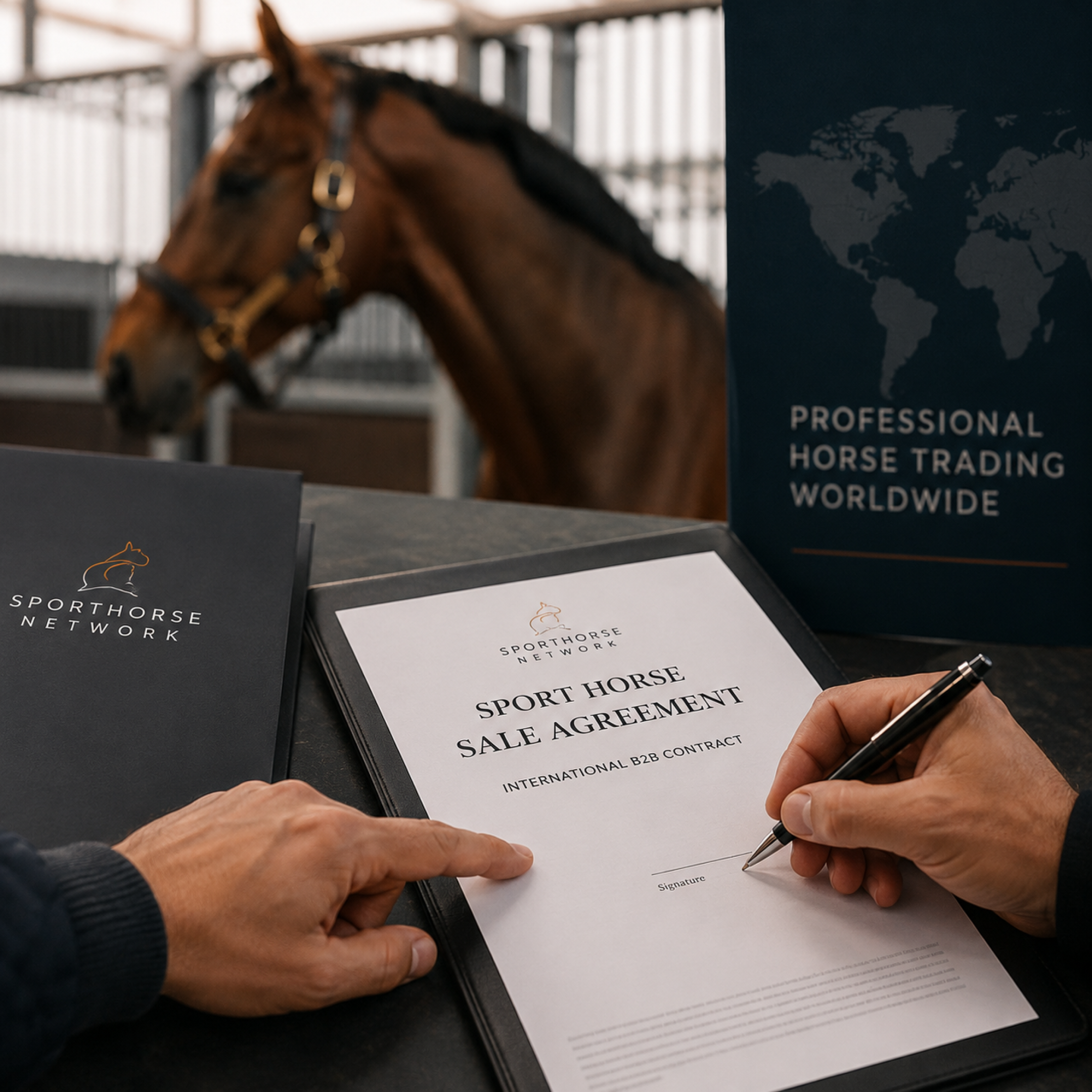
Legal Structure for International Sport Horse Sales in the High-End Market
In professional sport horse trading, standard sale agreements or outdated contract templates are still frequently used.
When selling a sport horse internationally in the higher segment, that is not efficiency — it is exposure to risk.
A professional sport horse sale contract is not a formality. It is a strategic instrument that:
• Prevents legal disputes
• Limits financial exposure
• Protects reputation
• Strengthens negotiation position
• Supports scalable international trade
When buyer and seller operate in different jurisdictions, the legal structure of the agreement largely determines the outcome in case of dispute.
Successful international horse trading begins with clear contractual frameworks.
Why International Sport Horse Sales Are Legally More Complex Than Often Assumed
A B2B transaction between the Netherlands and Germany differs fundamentally from a sale to the United States or the United Kingdom.
Key differences include:
• Consumer law versus professional (B2B) transactions
• EU VAT reverse-charge mechanisms
• Export and customs documentation outside the EU
• Warranty obligations per jurisdiction
• Differences in evidentiary rules
• Interpretation of non-conformity and misrepresentation
In some jurisdictions, a horse is strictly treated as a movable asset. In others, additional protective regulations may apply, particularly when a buyer is partly considered a consumer.
Without precise contractual wording, interpretation risk arises.
And interpretation risk means liability exposure.
Essential Elements of a Professional Sport Horse Sale Contract
1. Clear and Unambiguous Identification
A professional sport horse purchase agreement should include:
• Full registered name (passport)
• UELN number
• Microchip number
• Date of birth
• Gender
• Studbook registration
• FEI registration (if applicable)
International disputes often arise due to inconsistencies between commercial names and official registrations.
In the high-end segment, this is entirely preventable through precise documentation.
2. Purchase Price, VAT Structure and Currency Agreements
An international sport horse sale contract must clearly define:
• Whether the purchase price is inclusive or exclusive of VAT
• VAT reverse-charge application within EU B2B transactions
• Agreed currency of payment
• Exchange rate agreements if applicable
• Timing of full payment
Sport horses are frequently traded in:
• Euro (EUR)
• US Dollar (USD)
• British Pound (GBP)
If payment occurs in a different currency than the seller’s cost base, exchange rate fluctuations can directly affect net proceeds.
Practical example:
A German buyer purchases a show jumping mare from a Dutch stable.
The purchase price is agreed in USD.
Between deposit and final payment, the USD weakens significantly against the Euro.
No exchange rate clause was included in the contract.
Result:
• Unintended margin loss
• Renegotiation pressure
• Delayed completion
A simple clause fixing the exchange date or currency structure would have prevented this entirely.
Professional trading requires financial precision.
3. Risk Transfer and Delivery Moment
One of the most underestimated clauses in international sport horse contracts.
The agreement must clearly state:
• When risk transfers (upon signing, payment, departure from stable, or delivery?)
• Who bears responsibility during transport
• Who organizes transport
• What applies in case of injury or death during transit
In cross-border sport horse sales, this clause determines liability.
Without a clearly defined risk transfer provision, a single transport incident can lead to prolonged legal proceedings.
4. Pre-Purchase Examination and Termination Clauses
A pre-purchase examination (PPE) is standard in professional sport horse transactions.
Legally relevant aspects include:
• The timeframe within which the PPE must be conducted
• Scope of examination (clinical, radiographic, additional imaging)
• What qualifies contractually as a rejection
• Whether termination is full or partial
The distinction between:
• Visible defects
• Latent (hidden) defects
• Seller’s duty of disclosure
• Buyer’s duty of investigation
is legally critical.
Broad statements such as “fit for sport” can create exposure to non-conformity or misrepresentation claims if not clearly specified.
5. Warranties, 'As Is' Sales and Limitation of Liability
In B2B sport horse trading, liability can be contractually limited — provided it is properly drafted.
Key considerations:
• Explicit confirmation of a professional (B2B) transaction
• Clear definition of any sport performance warranty
• Exclusion of implied warranties where legally permitted
• Limitation of liability to the purchase price
• Exclusion of consequential damages
In certain jurisdictions, partial consumer status may still trigger consumer protection rules.
Clear legal positioning prevents disproportionate risk exposure.
6. Governing Law and Jurisdiction
An essential yet often overlooked clause in international sport horse sale agreements.
Without an explicit governing law clause, the law of the buyer’s country may apply.
The contract should specify:
• Applicable law
• Competent court
• Whether arbitration is preferred
International litigation is costly, time-consuming and reputationally sensitive.
Prevention is strategically superior to dispute resolution.
Common Mistakes in International Sport Horse Trading
• Using outdated contract templates
• No specific VAT provisions
• No clear risk transfer clause
• Overly general performance statements
• No multilingual legal review
• No tax coordination for non-EU export
• No currency or exchange rate agreement
These mistakes are not caused by inexperience — but by routine.
Routine is not a legal safeguard in international B2B horse trading.
Work with Specialized Equine Legal Experts
International sport horse transactions require sector-specific legal expertise.
Professionals frequently collaborate with specialized equine law firms such as:
• Equestrian Legal Solutions (US / International)
• Moore & Co – UK Equine Law (United Kingdom)
• Hemington Scott – Equine Law (UK)
• Peacocke & Simpson – Bloodstock & Equine Law (Ireland)
• Foster Swift – Equine Industry Group (US)
• Cummings & Lockwood – Equine & Bloodstock Practice (US)
• Van Doorne – Sport & Equine Law (Netherlands)
Periodic review and updating of sale contract templates is a strategic investment in risk management.
Professionalization as a Strategic Advantage
The international sport horse market is evolving towards:
• Greater transparency
• Direct trading structures
• Broader international reach
• Higher transaction values
This requires mature legal and financial frameworks.
Within a controlled professional network such as Sporthorse Network, transactions are conducted directly — but always within clearly defined contractual boundaries.
A strong sale contract is not a sign of distrust.
It is a sign of professionalism.
Conclusion
A professional international sport horse sale contract should include:
• Unambiguous identification
• Fiscal clarity
• Clear risk transfer provisions
• Precise pre-purchase examination clauses
• Clearly defined warranty and liability terms
• Governing law and jurisdiction
• Defined currency and payment structure
Selling a sport horse internationally without a solid contractual structure is not efficiency — it is avoidable risk exposure.
Professional trading begins with preparation.
Where Professionals Find Horses.